
Finding your first customers is the hardest thing you’ll do in the early days as a founder. You have no reputation, your product doesn’t work, and you need to convince strangers to give you their time.
At my previous startup, Iteratively, we tried a lot of things, most of them didn’t work.
What did work was hanging out in Slack communities where we knew our ICP was as well. I’d watch the issues people were grappling with and then write up a blog post to help. From then on, anytime someone had a question, I’d be able to hop in and help right away. That early trust-building gave us nearly half of our early customers.
To find your first channel, you’ll need to find the right alchemy of something that results in calls and meetings but doesn’t require some endless Herculean effort. I call it the Founder-Channel Matrix.
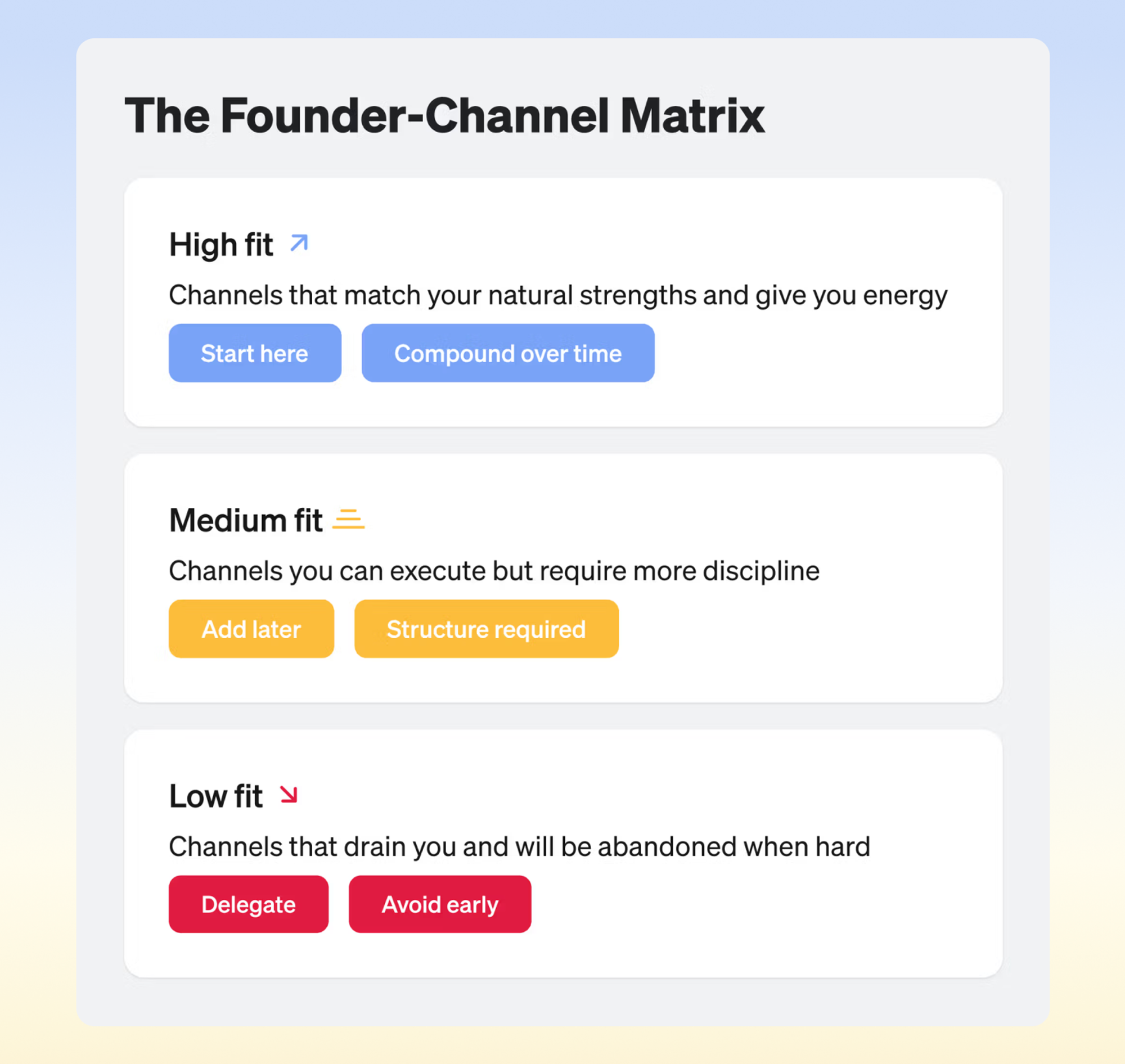
At Iteratively, the channel was Slack communities.
At Clarify, it's LinkedIn. And the basic approach is the same: show up where our ICP already is, be genuinely helpful, and let trust compound.
“LinkedIn to me is my golden goose,” says Elaine Zelby. Elaine told me she’s built up to running four separate plays on LinkedIn that help build pipeline for her company, Tofu.
Most of the founders I know have some version of a LinkedIn playbook at the start—and these are playbooks you can copy. In this post, we’ll cover the two broad buckets of LinkedIn motions: Inbound and Outbound—with a few advanced tips at the end.
LinkedIn for inbound
You can go to the people, or you can make the people come to you. You’ll probably do a mix of both, but the inbound plays compound more over time.
Share your founder story
If your ICP is other small companies or executives, share what you and your team are working on. The wins. The failures. The frustrating nights.
Not only will you get great advice and offers to help, but this “working in public” approach also makes more people aware of the problem you are trying to solve. It humanizes the team behind the screen.
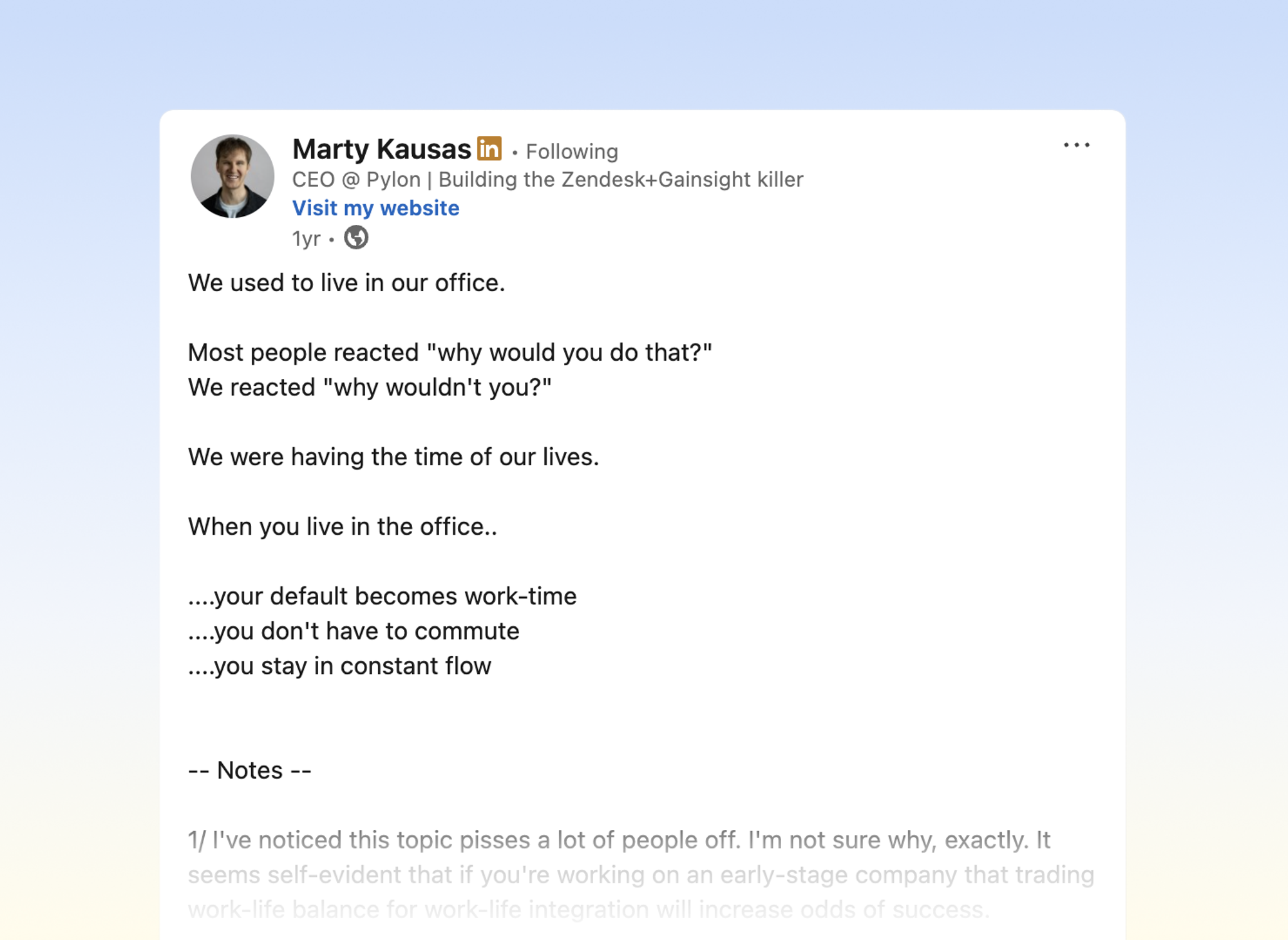
"People love storytelling, and they love hearing not just about what you're building, but the story of how you built it,” says Marty Kausas, co-founder of Pylon. His lightning-bolt moment came when, on a whim, he shifted from sales-y content to a more storytelling approach after a breakout post skyrocketed to 300,000 impressions and sparked a wave of demo bookings.
“[That post] shifted our strategy from, ‘hey, let's just talk about the problem we're solving or our product’ to instead ‘talk about the story behind all of those things.’"
Put more good into the world than you take out, and you’ll get some of that back.
Be a person first, CEO second
Company accounts don’t do well on LinkedIn for a reason: people want to hear from other people who (and this is important) are acting like actual people.
"People aren't buying things from companies. They're buying things from other people,” says Bobby Pinero, co-founder of Equals. “The more that I've cultivated relationships and serendipitously bumped into people, the more magic that has happened.”
Even GTM motions that rely on long enterprise sales cycles benefit from a little humanity.
“The founders of those [larger] companies, if they see your content, are going to recommend your product to their team,” says Marty. “And so you actually get this amazing effect, which is like, ‘Hey, you've basically got an exec approval for whatever product that you're selling.’ So you almost work your way from the top to the bottom."
People don’t care about your company (yet). But they do care about you.
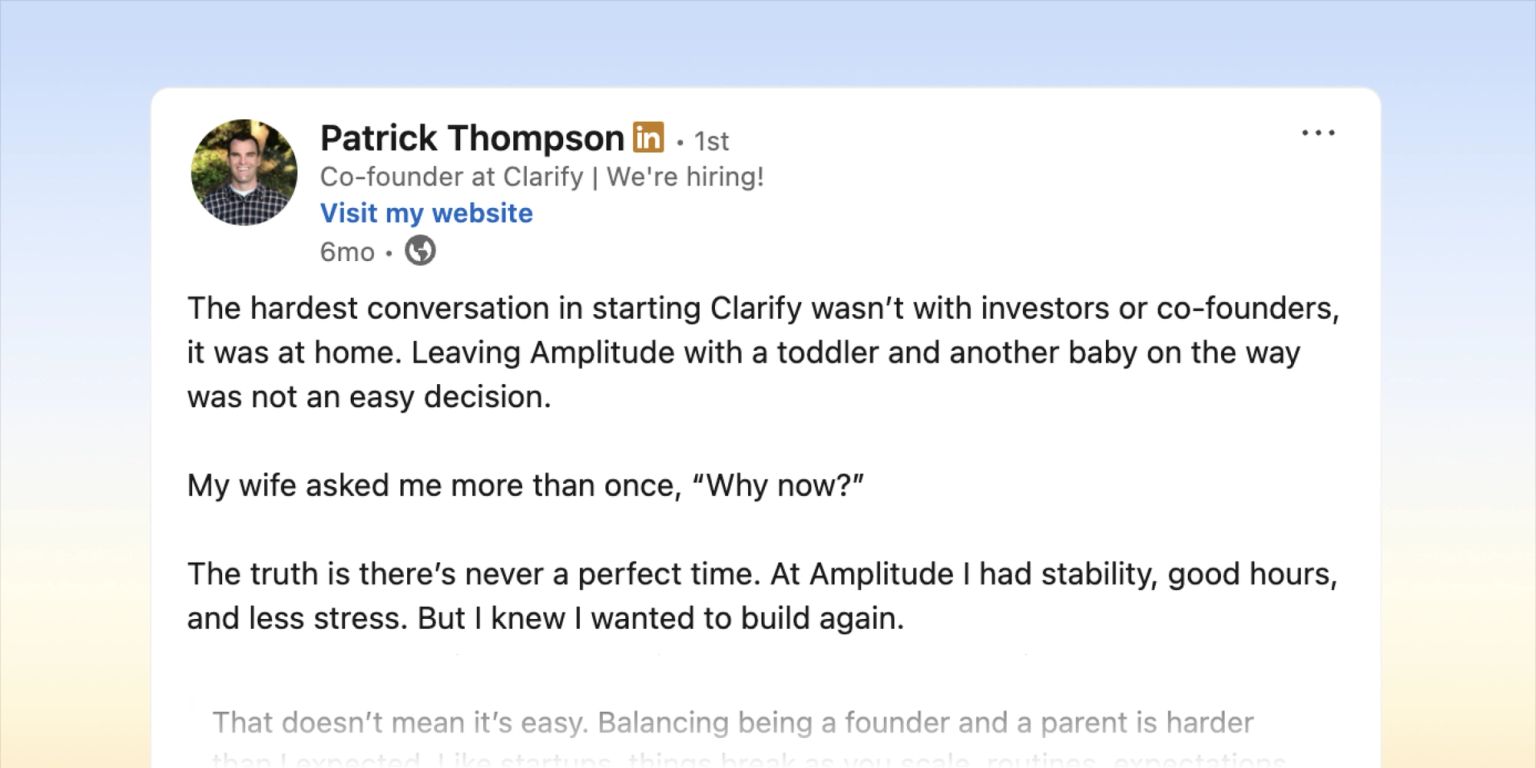
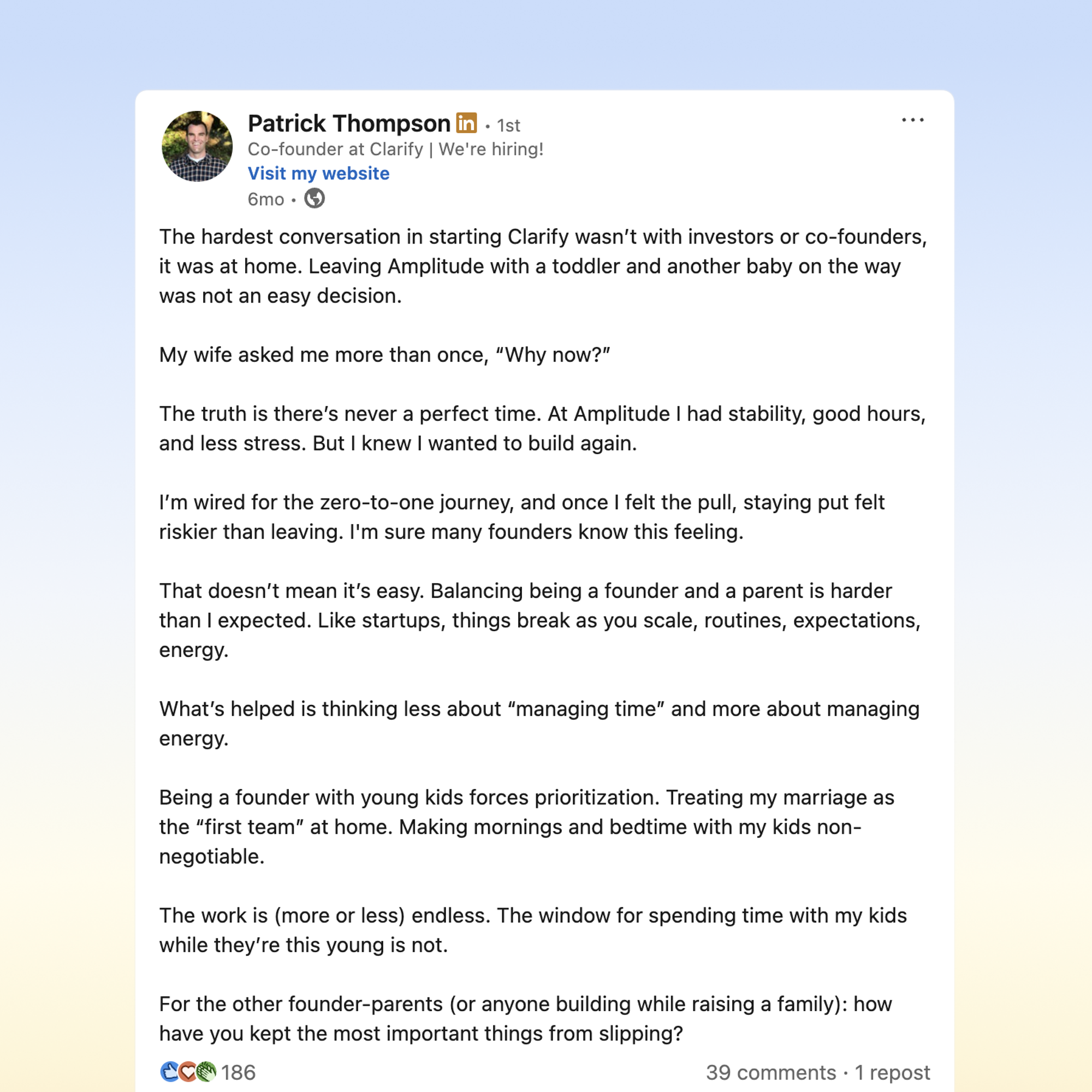
Here’s one of the more personal posts I’ve written, which cuts through the “everything is amazing all of the time” tenor of some startup insights and focuses on the real stuff.
Its success solidified a valuable lesson: talking authentically about myself isn’t promotional, it’s humanizing.
Don’t overthink it
On the internet, no one can hear you fail.
That’s a feature, not a bug.
I had never written before and had never been “public,” so posting on LinkedIn didn’t come naturally to me. So I treated it like what was natural to me: building a product. I would post, get feedback, and iterate.
And I would try not to over-engineer it.
“My posts that I just do spur of the moment without overthinking it, without crafting it, do the best. It's just a pure, authentic stream of consciousness," says Elaine.
Especially if you’ve never written publicly before, you need reps. Because finding your voice takes time.
The upside is that the feedback loop is fast — you know what resonates within 24 hours. (Or, you can export each post's content and analytics to your preferred AI agent and have it start to point out patterns.)
If you don’t know where to start, just write for an audience of one.
“I'm really not trying to appeal to a certain audience,” Marty told me. “I'm trying to appeal to myself.”
LinkedIn for outbound
Once you feel the inbound and organic flywheel spinning, you can start to scale. And that’s when the magic starts to happen.
Once you feel the inbound and organic flywheel spinning, you can start to scale. And that’s when the magic starts to happen.
Be 100% human, 0% AI
Don’t use these spam cannon AI tools for your outreach. Not for early-stage founder-led sales.
They all promise something that we just haven’t seen work: personalized, scalable cold outreach.
Riya Grover, co-founder of Sequence, explains why:
“We've actually reverted back to having people in our team do that work. The kind of personal things that we can put into messages go well beyond what an AI SDR might be pulling. An AI SDR might be saying, 'I saw you started this new job' or 'I noticed [insert some generic thing].' Actually, the things that resonate are, 'Hey, by the way, I saw you chimed in on this other LinkedIn thread, and it seems like this is a topic that's interesting for you.' Or 'We have this person in common, I know them from here, they suggest that we speak.' That human element, when there's so much noise, actually helps to drive really, really high-quality pipeline.”
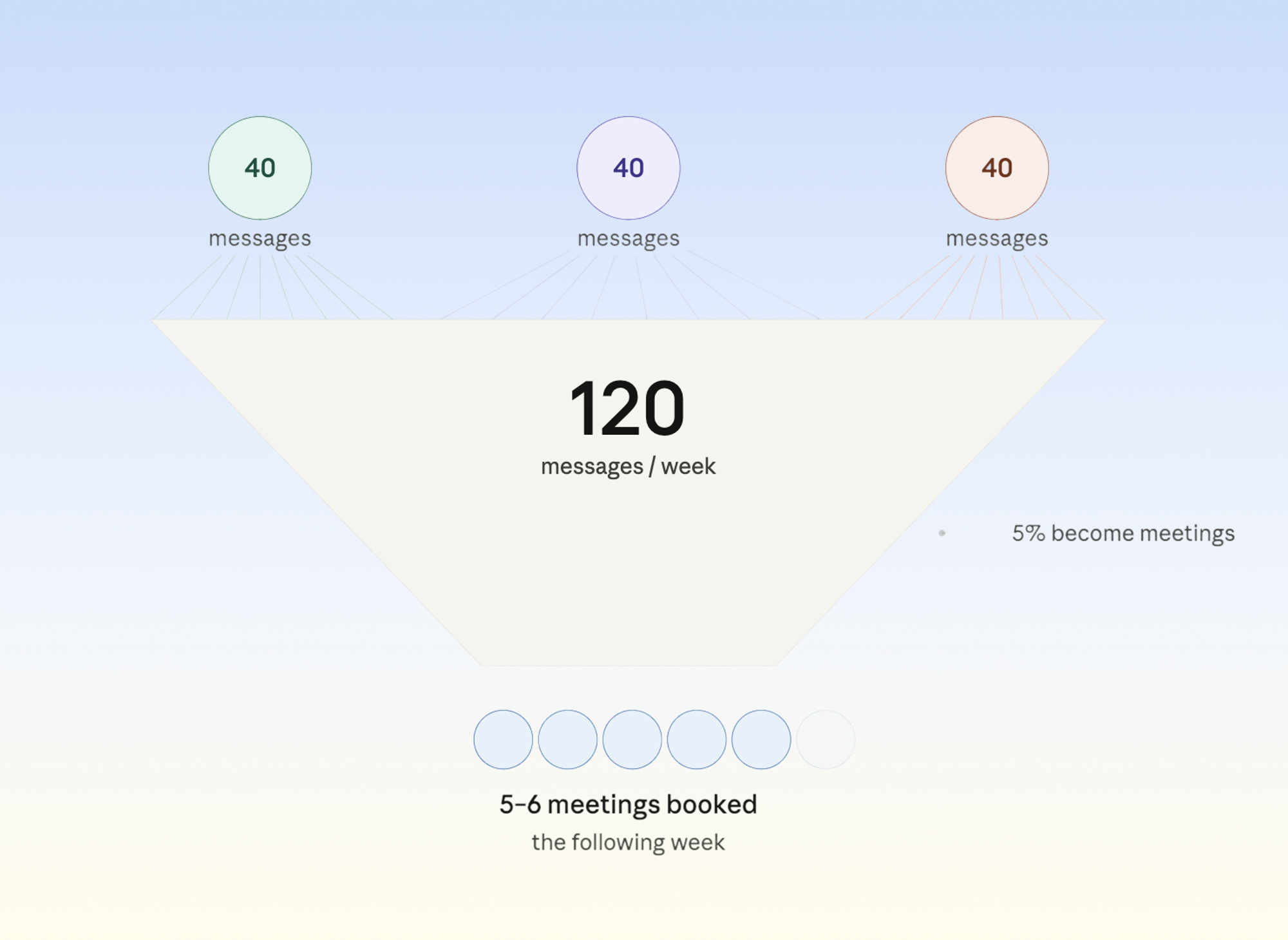
Marty says Pylon did everything manually, with each of the three co-founders sending messages themselves. Their rough funnel:
Frame your outreach as discovery
When I reach out to people, I never frame it as a sale. I tell them I’m doing discovery, and I just want to learn what problems they are facing.
Don’t fake discovery to sneak in a pitch. When you’re just starting out, discovery can be just as useful as revenue.
"Initially, the way we phrased it was advice because we were so new to the space,” says Marty. “And it was true. We were more so looking for guidance. And then a lot of those people ended up converting into customers because they actually really had the problem."
A cornerstone of founder-led sales is continuous discovery, always learning from your market and incorporating those lessons into your product and GTM motions. You should get to the point where you can reliably guess your customer's language and their pain points.
As a founder, those loops can be really tight, and they also offer an “excuse” to reach out.
“It was a lot of hustle to get into doors, leveraging everyone in our network, their first degree connections on LinkedIn, their second degree connections on LinkedIn, to really try and find people who might be interested in talking to us about this problem," says Riya.
Advanced plays and tips
Once you’ve got the basics down, here are some other things that worked for the founders and us, I know:
Influencer marketing via LinkedIn.
Follow members of your ICP and track who they are sharing with and what they are commenting on. B2B influencers are a relatively nascent space, and there's a lot you can do informally. “We are finding people that are already posting content that we would have posted anyway,” says Elaine. Tofu also invites influencer partners to co-host LinkedIn Live sessions as a way to test the waters.
Pre-launch planning.
Start experimenting with posting and outreach long before you officially launch your product. You’ll learn more about your market and have a built-in audience to amplify your big news. There’s a reason our funding announcement and launch was shared so widely.
Include a “how did you hear about us” in your closing process.
This is the most straightforward way of seeing if your LinkedIn posts are resulting in pipeline.
Eventually, expand.
Each founder who started with LinkedIn eventually diversified their efforts. (See more on getting your first 10 customers.) "I would definitely consider the other channels,” says Enzo Avigo, co-founder of June. “Connect with people on an ongoing basis, whether it's a newsletter or social media or producing content. It doesn't sound like sales at first, but I think this is more the nature of what sales is going to become."
LinkedIn isn’t a magic hack. It’s a long-running conversation with the market that takes time to hone. You don’t need to be an expert on building a company or on LinkedIn. You just need to be you.
Keep Reading
The mindset shifts needed for successful founder-led sales
How to run a sales call (in the early days)
When to hire sales (and how to do it)
What users are saying about Clarify: a collection of reviews from 2025
We built an online arcade using only AI: Here's why (and how)
A founders guide to channel experimentation: How startups can test marketing channels effectively