
Building a sales process when you’re still trying to hit those first growth milestones is tricky. But relying on advice and models from enterprise sales leads with hundreds of salespeople working under them creates more problems than it solves. This is especially true when planning your deal pipeline.
Breaking up your pipeline into the right deal stages doesn’t just create a clear process for your salespeople to follow; it serves as the baseline for planning sales initiatives and gives you the data you need to evaluate their success.
Here’s how your small business can set the right deal stages.
How to build a sales process with effective deal stages in a small business
When you’re running a small business, your processes often either live in someone’s head or are made up on the fly. You’re focused on growth, and whatever the next task in line is to get you that growth. So when it comes to deal stages, you’re likely to just go with whatever’s already in your CRM. But are they really a fit for your needs?
Here’s how you can tell.
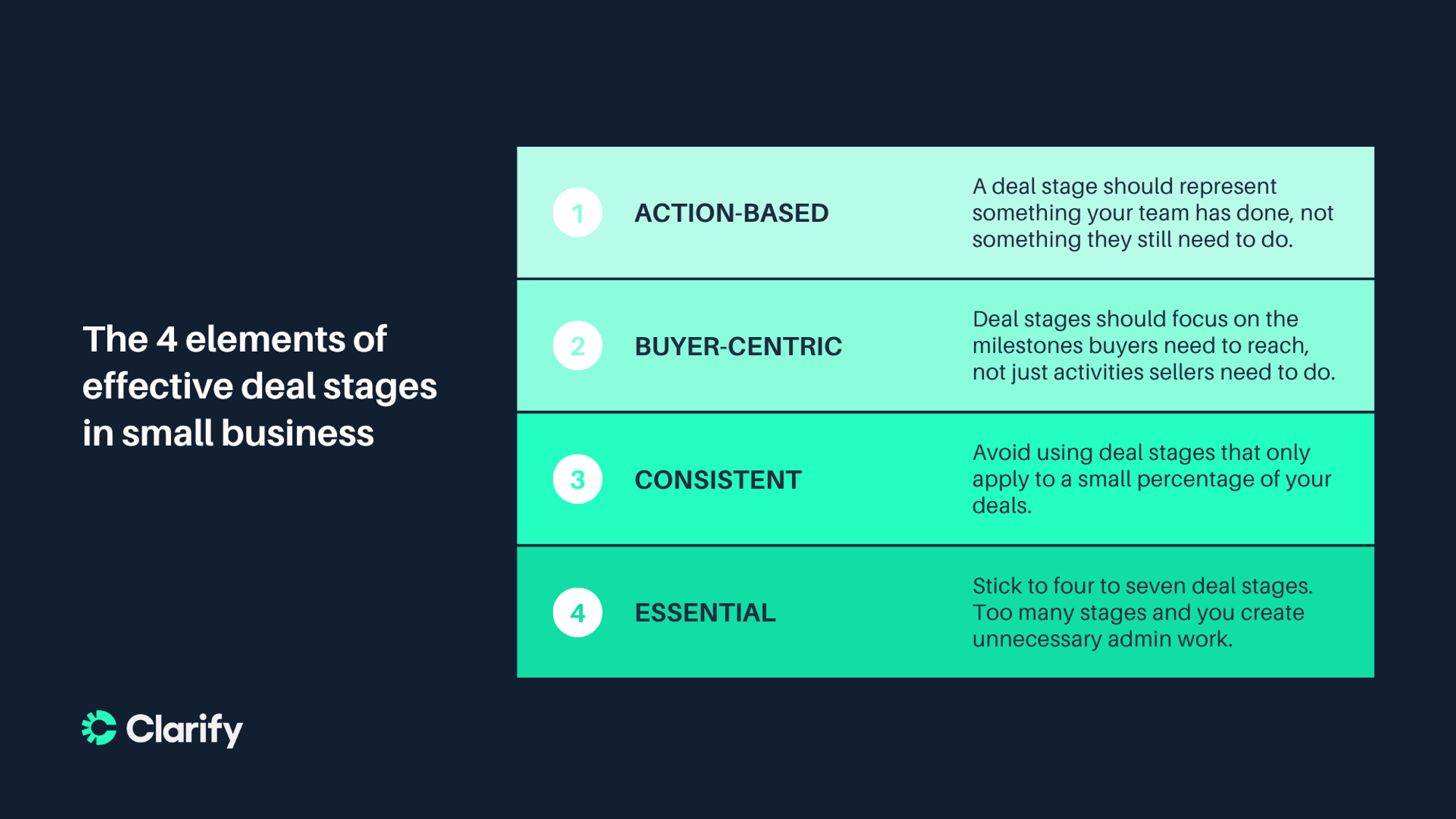
Deal stages should be action-based, not status-based
A deal stage should represent an action that your team takes, not something they’re working on. Think of a deal stage as a checkbox, a sign of something you’ve completed, rather than the start of something new.
Good examples of action-based deal stages include:
- Demo completed
- Proposal sent
- Contract signed.
Bad versions of these same stages would be:
- Demo requested
- Writing proposal
- Approving contract
The nuance is subtle but provides a much clearer picture of where a deal stands and what needs to happen to move it forward.
Buyer-centric, not seller-centric
While deal stages can serve as a checklist of things that need to happen before a deal is won, they shouldn’t be considered a to-do list for your sales team.
They should actually be markers of a buyer’s increasing commitment. When setting deal stages, take the buyer’s perspective. What needs to happen for them to make a decision?
Examples of buyer-centric deal stages include
- Trial started
- Pricing approved
- Stakeholder demo completed
Examples of seller-centric deal stages include
- Send follow-up
- Prepare quote
- Schedule call
Again, the nuance is subtle, but seller-centric deal stages are a better fit as tasks in your CRM.
Don’t build stages around edge cases
Your deal stages should represent a logical process that the vast majority of your deals follow. If too many deals seem to skip past a certain stage, that might mean you need to reevaluate each stage. Avoid using stages that only apply in a small percentage of deals, like technical deep-dives.
Between four and seven stages
The more deal stages your pipeline has, the more administrative work you create for yourself or your sales team—meaning they’re spending less time selling. Conversely, too few deal stages mean you don’t have an accurate map of your sales process. That means you’ll have less reliable data, a confused sales team, and important deals falling through the cracks.
The foundational 4-stage framework for small businesses
As you’ll see below, deal stages can vary depending on your industry, the size of your team, and your average deal cycle. That being said, there is a broadly applicable framework that’ll let you set a strong foundation for your pipeline that you can expand on as needed.
Here’s that foundation. Every stage will list entry criteria (when a deal lands in that stage), exit criteria (what needs to happen to leave that stage), and why it matters.
Stage 1: Qualified
Deals usually enter this stage after a discovery call is completed, a budget is confirmed, or a decision timeline is identified. They leave this stage when a prospect agrees to a demo or a proposal.
This deal stage is essential for filtering out prospects that have no intention of buying or take too much time away from your sales team with tasks that lead nowhere.
Stage 2: Demo completed
Deals enter this stage once prospects have sat through a demo. They usually exit this stage when a prospect schedules a decision call or requests a contract.
This deal stage shows that a prospect is serious about buying beyond their initial interest, meaning you don’t waste time negotiating terms with a prospect who’s still considering their options.
Stage 3: Contract terms sent
Once you send a prospect a contract, a deal can enter this stage. When you receive a signed contract from a prospect or confirmation that they won’t be moving forward, a deal is ready to exit this stage. There might be some back and forth on specific terms, but the contract is out there.
This stage separates prospects who are just interested in what you’re selling from those who are ready to buy and just need to check a few boxes off before they do.
Stage 4: Closed won/closed lost
A deal is won when you receive a signed agreement or purchase order, and it’s lost when a prospect explicitly passes on your offer or goes dark for over 30 days.
This stage doesn’t just matter because it celebrates your victories and charts your losses; it gives you clear conversion data and reasons why deals are won or lost.
4 examples of industry-specific deal stage variations
The foundational deal stages above will give your small business everything it needs to start properly tracking your sales process, improving your deal cycles, and hitting that next milestone. But as your process improves, you may want to adjust your deal stages to your industry. Here are a few examples of industries and their respective deal stages.
Deal stages for small businesses in SaaS and software
The most common five deal stages for this industry are:
- Qualified
- Trial started
- Trial engaged
- Contract terms sent
- Deal won/lost
Why the two stages for a trial? In software, a lot of work goes into making the trial a large part of converting new users, and the extra step gives product and sales teams important data.
Deal stages for small service businesses
In service businesses, you’ll usually find the following deal stages:
- Needs assessment completed
- Scope/proposal sent
- Contract under review
- Deal won/lost
Services businesses—especially smaller ones—typically have faster sales cycles and fewer stakeholders
Deal stages for small businesses with long sales cycles in B2B
Some small businesses have longer sales cycles, especially in B2B sales. Here’s what those deal stages might look like:
- Qualified
- Technical demo completed
- Stakeholder demo completed
- Proposal sent
- Contract negotiation
- Legal review
- Deal won/lost
This long sales cycle covers multiple buyer personas and necessary buy-in from both technical teams and other stakeholders.
Deal stages for small businesses in e-commerce
In e-commerce, an industry with few touchpoints for a sales team, you’ll usually find the following deal stages:
- Cart abandoned
- Follow-up sent
- Purchase/lost
E-commerce is a high-volume industry with a short consideration period. This simple pipeline reflects that.
Common mistakes when setting deal stages
If you’re straying from your CRM’s default deal stages for the first time, you’re bound to make a mistake or two. Here’s how you can prevent that.
First mistake: Too many stages
Breaking your pipeline into more deal stages can feel like the right move. It gives you more data and more granularity, right? In reality, it just overwhelms your teams. Start with four deal stages and add no more than one per quarter, after evaluating how your pipeline supports your goals.
Second mistake: Ambiguous stage definitions
When your deal stages are overly ambiguous, it’s tough to tell what needs to happen for a deal to enter or leave them. By clearly documenting deal stages, entry and exit criteria, and the like, you’ll get better data and a clearer sales process.
Third mistake: Stages that don’t match reality
Your CRM’s default deal stages can be a good place to start, but they’ll rarely be a perfect fit for your sales process, especially as you grow. But changing deal stages just for the sake of changing them doesn’t work, either. Any time you want to change deal stages, shadow five or more recent deals. Look at what actually happened and build your deal stages around that.
Fourth mistake: No stage probability mapping
Deal stages shouldn’t just be names on a board. Probability mapping assigns a win percentage to each stage, allowing you to properly forecast according to historical close rates. Without win percentages, you can never really know how accurate your data is.
Not sure where to start? Here’s a quick framework for you:
- Qualified: 20%
- Demo/Proposal: 40%
- Negotiation: 70%
- Closed Won: 100%
You can (and should) adjust these numbers when you have more data.
Fifth mistake: Not optimizing deal stages over time
Defining deal stages is hard work, and many sales teams never revisit them. That makes them less and less applicable as you grow. You should review your deal stages regularly to keep them optimal. Here’s how:
- Review stalled deals monthly: Flag deals sitting in one stage for too long. Take action on them, whether that’s moving them to the next stage, moving them back to an earlier stage, or marking them as lost. You’ll use that to optimize deal stages in the future.
- Analyze conversion rates quarterly: Calculating stage-to-stage conversion can help you identify the biggest drop-off and decide where to focus your improvement efforts, whether that’s in your sales strategy or in your deal stages.
- Refresh stage definitions biannually: As your business evolves, the deal stages you set might not make sense. Review them to see the ones that get skipped too often, and remove them or merge them into others. Review how many deals move backwards and, if it happens too often, re-evaluate the criteria in each stage. Finally, analyze any recent changes to your sales process and align your deal stages with them.
Sell stage by stage
Clearly defining deal stages and reevaluating them over time helps you build a stronger sales process, get better data, and close more deals. But what about all the work that actually happens throughout those stages? Most CRMs only serve as a space for your deals to sit as your teams do hours of manual work, most of it not even the actual selling work they love to do.
That’s where Clarify comes in. Clarify is a fully autonomous CRM that automates pipeline creation, meeting admin, and CRM updates, so you can put your focus back on the tasks that actually win you deals.
Want to see what Clarify can do for your pipeline? Try it for free.
Keep Reading
Sales pipeline for small business: How to build & manage one
Startup sales pipeline: How to build, manage, and optimize
B2B sales process: A stage-by-stage guide for small teams
CRM setup for founders: A step-by-step guide
Best CRM for small business: 11 platforms compared
How to increase sales productivity as as founder or small team